

 By Admin |
  September 10, 2026
Hydrogen is beginning to gain importance as one of the key elements that will help in achieving the global shift towards renewable energy. With industries looking at new methods of doing things instead of using traditional fossil fuel energy systems, green hydrogen generated using water electrolysis has begun to draw considerable interest. One such technology that stands out is Anion Exchange Membrane (AEM) electrolysis due to its unique nature.
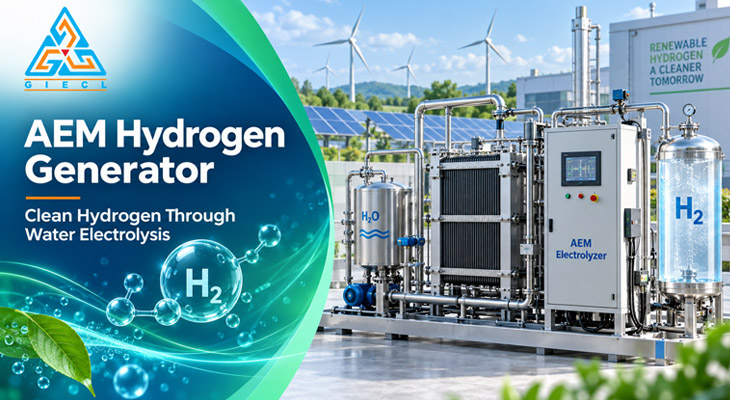
Understanding AEM Hydrogen Generator technology involves how it makes use of an Anion Exchange Membrane, which helps in electrochemically separating water into hydrogen and oxygen. Energy is provided to the electrolyzer, and when the energy is renewable (sun or wind), the production of hydrogen will have very little or no carbon footprint at all.
Unlike conventional alkaline electrolysers, AEM systems use a solid polymer membrane as the electrolyte separator. At the same time, AEM technology is designed to operate in an alkaline environment, creating opportunities for the use of less expensive catalyst materials compared with some PEM configurations.
This combination is one of the reasons why researchers, energy companies, and equipment developers are exploring AEM technology for future hydrogen production.
One of the most interesting aspects of AEM electrolysis is its potential to reduce dependence on certain precious-metal catalysts. PEM electrolysers can rely on expensive materials for specific electrode reactions, while AEM systems may offer greater flexibility in catalyst selection.
For hydrogen projects where equipment cost is an important consideration, this potential could make AEM technology increasingly attractive as the technology matures.
The membrane-based architecture of AEM electrolysers can support compact system configurations. This can be particularly useful for applications where available space is limited or where hydrogen needs to be generated close to the point of use.
Modular designs can also provide flexibility for businesses that want to start with a smaller hydrogen-generation capacity and expand their systems as demand increases.
Green hydrogen production depends heavily on access to renewable electricity. Solar and wind power, however, can vary throughout the day and across seasons.
AEM technology is being developed with the goal of supporting flexible hydrogen production alongside variable renewable power. This makes AEM electrolysis particularly interesting for decentralised and renewable-energy-integrated hydrogen projects.
The hydrogen economy will require systems that can support applications ranging from smaller on-site installations to larger industrial projects. AEM electrolysers have the potential to be developed in modular configurations, allowing capacity to be adapted to project requirements.
As research and commercialisation progress, improvements in membrane durability, efficiency, current density, and system integration could further strengthen the technology's role in the hydrogen market.
Hydrogen can be produced through several electrolysis technologies, including alkaline, PEM, and AEM systems. Each has its own advantages and engineering considerations.
Alkaline electrolysis is a mature technology that has been extensively used industrially. PEM electrolysis has high current densities and dynamic operations which make it appropriate for some renewable energy systems. AEM seeks to bridge aspects of these technologies by combining a membrane-based architecture with alkaline electrochemistry.
The right technology ultimately depends on factors such as hydrogen production capacity, electricity source, water quality, operating conditions, cost objectives, and application requirements.
The business should take into consideration the technical experience, design capability, quality of parts, safety provisions, automation capability, maintenance considerations, and customization capability of the manufacturer.
Working with an experienced AEM hydrogen generator manufacturer can help businesses evaluate their hydrogen requirements and identify a system configuration appropriate for their intended application. GIECL is a leading AEM hydrogen generator manufacturer in India, offering expertise and solutions aligned with the evolving requirements of the hydrogen industry.
For GIECL, the growing interest in advanced hydrogen technologies reflects the broader movement toward innovative water, chemical, and clean-energy solutions. With the hydrogen sector developing rapidly, reliable engineering and application-focused system design will remain essential.
AEM technology is not necessarily a replacement for every existing electrolysis technology, but it offers an exciting route for further innovation. Continued development could address some of the current challenges associated with membrane durability, catalyst performance, efficiency, and large-scale manufacturing.
As renewable electricity becomes increasingly integrated into energy systems, technologies capable of converting that electricity into storable hydrogen will become more valuable. AEM electrolysis could play an important role in this transition by offering a flexible platform for producing hydrogen from water and renewable power.
The future of hydrogen generation is unlikely to depend on one technology in all possible applications, but rather a combination of different technologies in the future. AEM could very well be one of these technologies, with further research and commercialization.
Yes. AEM electrolysis can use renewable electricity from sources such as solar and wind, making it a potential technology for green hydrogen production.
Both involve electrolysis using a membrane, but have varying ionic species and electrochemical conditions. The AEM process occurs in an alkaline environment while the PEM system involves a proton conducting membrane in an acid environment.
Potential advantages include compact system design, compatibility with renewable electricity, modularity, and the possibility of using lower-cost catalyst materials.

309, Sarthik Square , TGB service
road, Near Info Tower,
S. G. Highway, Bodakdev,
Ahmedabad-380 054, Gujarat, India


© Copyright 1996 - Gujarat Ion Exchange And Chemicals Limited. All Rights Reserved
Powered By: #1 Vinayak InfoSoft - SEO Company Ahmedabad

 Ahmedabad, Gujarat
 +91 92281 90646
 sales@giecl.com
