

 By Admin |
  September 03, 2026
Water treatment for industrial applications is now more than just purifying the water of contaminants. As there is an increasing challenge for industries to control their operation expenses, conserve water, and ensure consistency of water quality, it is now time for the water treatment systems to provide high efficiency and reliability of operation. Here comes the importance of reverse osmosis technology.
As leading manufacturers of Reverse Osmosis Systems, we at GIECL know how diverse the demands of industries are for water quality in terms of the sources, applications, chemistry of water, and quality demanded. Therefore, modern RO systems can be designed specifically for particular operations.
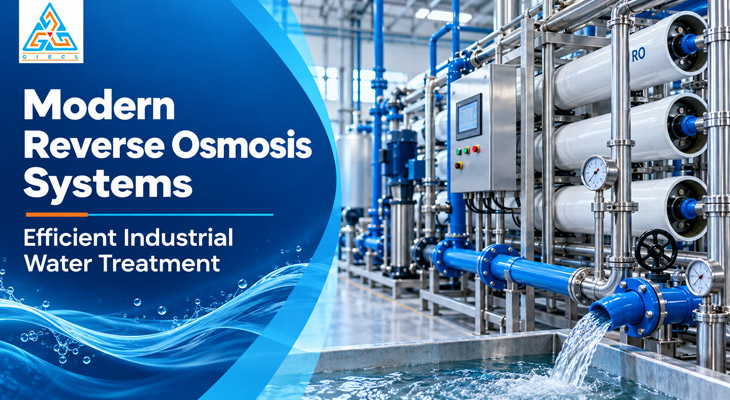
Reverse osmosis involves using pressure to force water through a semipermeable membrane, which acts to separate many dissolved salts and impurities from the purified water. However, the performance of an RO plant goes well beyond the membrane alone.
Modern systems combine appropriate pre-treatment, membrane technology, monitoring, automation, and process design to achieve reliable results. GIECL offers industrial RO plants designed for different applications and water conditions, including brackish water treatment and industrial processes.
One of the most important developments in efficient RO operation is better feed-water preparation. Suspended particles, hardness, chlorine, and other contaminants can affect membrane performance if they are not adequately controlled.
Pre-treatment systems like filtration, softening, dechlorination, and anti-scalants can be used to protect RO membranes and ensure their continuous operation. According to GIECL, proper pre-treatment must be carried out before the RO plant treats the water.
This helps in preventing membrane fouling and extending the membrane's lifespan.
Modern RO plants increasingly use automated controls to monitor and manage important operating parameters. Automated systems can help operators maintain appropriate pressure, flow, and water-quality conditions while reducing dependence on continuous manual intervention.
For industrial facilities where water treatment runs continuously, improved control can translate into more consistent performance and smoother plant operation. GIECL's RO solutions include automatic systems and designs developed according to different capacity requirements.
Industrial water is not the same everywhere. A food-processing facility may have different requirements from a pharmaceutical plant, boiler system, dairy facility, or manufacturing unit.
Modern RO systems can be configured according to feed-water characteristics and the required output quality. GIECL provides RO solutions for applications including food and dairy industries, beverages, boilers, cooling towers, drinking water, and other industrial requirements.
This application-specific approach can help industries avoid investing in a system that is either undersized or unnecessarily complex.
The water quality may also vary with time depending on the level of dissolved solids in the source water. It is important to monitor the various parameters in order to detect any variation before it impacts the treatment process.
Modern RO plants can incorporate instruments and control systems that provide better visibility into plant performance. GIECL's advanced RO installations include features such as online pH and TDS control, flow measurement, VFD-driven pumps, and PLC/HMI-based operation in selected systems.
Efficiency is not limited to energy consumption. Water recovery and reuse are also becoming increasingly important for industries facing water scarcity.
An appropriately designed RO system can help industries treat water for reuse in suitable processes, reducing dependence on fresh-water sources. RO technology is already used for treating brackish and high-TDS water for industrial applications.
For facilities looking to strengthen their overall water-management strategy, RO can therefore become an important part of a broader treatment and recycling system.
Reverse Osmosis of today is moving away from being a simple water purification process to becoming an integrated process for water management. Pre-treatment, automation, control systems, design to suit the application, and water reuse are some aspects which are leading industries to treat water efficiently.
For businesses planning a new RO plant or upgrading an existing system, working with experienced Reverse Osmosis System Manufacturer can make the difference between simply treating water and developing an efficient, sustainable water-treatment process.
An industrial RO system uses pressure and semi-permeable membranes to remove dissolved salts and many contaminants from water for industrial or process applications.
Pre-treatment helps reduce contaminants that can cause scaling, fouling, or membrane damage, supporting better RO performance and maintenance.
Automation, improved pre-treatment, process monitoring, appropriate membrane selection, and application-specific system design can contribute to more reliable and efficient operation.

309, Sarthik Square , TGB service
road, Near Info Tower,
S. G. Highway, Bodakdev,
Ahmedabad-380 054, Gujarat, India


© Copyright 1996 - Gujarat Ion Exchange And Chemicals Limited. All Rights Reserved
Powered By: #1 Vinayak InfoSoft - SEO Company Ahmedabad

 Ahmedabad, Gujarat
 +91 92281 90646
 sales@giecl.com
