

 By Admin |
 October 01, 2026
Green hydrogen is getting attention as industries look for cleaner ways to produce energy. Electrolysis is one of the most common methods employed in the production of hydrogen from water by passing an electric current through water to separate it into hydrogen and oxygen. It requires water to meet certain standards of purity since it cannot always be supplied in its raw form.
This is where the importance of Green Hydrogen Water Treatment comes into play. An appropriate water treatment process is used to remove unwanted substances and to prepare water for hydrogen production. The number of treatment stages depends on the quality of water available and the needs of the electrolyser.
The quality of water is an important factor that influences the efficiency and maintenance of the electrolyser. The electrolyser may contain various kinds of ions due to the presence of minerals and other substances that negatively affect the electrolysis process. Using untreated water leads to higher chances of deposits, contamination and maintenance problems.
That is why it is necessary to analyse water quality before choosing the treatment system. Such factors as total dissolved solids (TDS), hardness, conductivity and the presence of some contaminations are very important for this purpose.
The goal is not just to appear clean, but to look clean as well. It is to achieve the water quality specified for the particular hydrogen production technology.
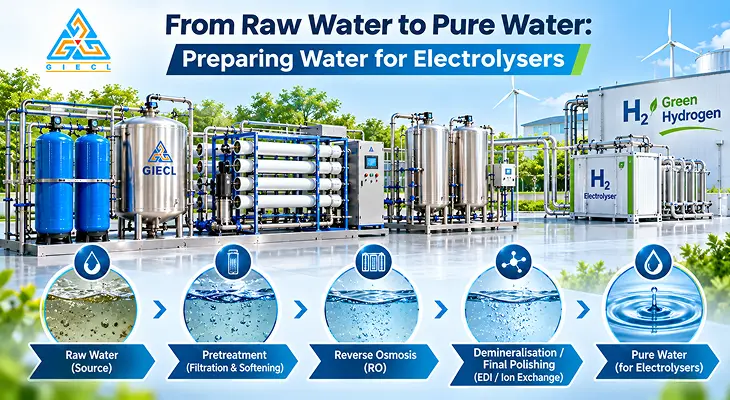
Many treatment steps are possible in the preparation of the water for electrolysis. The specific configuration will depend on the raw water source(s) and the required end purity.
The first thing to be known is the quality of the raw water. The source of water can be a bore well, municipal, surface or any appropriate water source. The amount of dissolved minerals and suspended substances in each source may differ.
The pre-treatment process may involve either sand filtration, activated carbon or water softening depending upon the outcome of the tests. Such procedures ensure the elimination of suspended solids along with some specific impurities and hardness from the water.
Reverse osmosis (RO) is a widely employed process for decreasing the dissolved salt content and other impurities from water. In this process, water is forced through a semi-permeable membrane under pressure. Much of the dissolved material is separated from the treated water by means of the membrane.
RO is one of the important components of Green Hydrogen Water Treatment, especially if the source water is highly saline. But RO alone might not be sufficient for the end product purity desired by all electrolysers.
RO may be followed by further treatment to further lower the remaining dissolved ions. This can be done by using ion exchange, electrodeionisation (EDI) or another appropriate polishing method as required to meet the required water quality.
The stages help to achieve the required conductivity or ionic purity within the limits. The chosen system needs to be in accordance with the recommendations of the electrolyser manufacturer, and not a standard setup for each project.
After the process of treatment, the water needs to be stored and transported without adding more contamination to it. The materials used to store the water should be compatible with the water quality requirements.
The testing of conductivity and other factors will help the operator to detect any change in water quality. Maintenance of filtration systems, membranes, and polishing units is also important.
Not every hydrogen project needs the same treatment arrangement. A system for a low-salinity municipal water source is not the same as a system for a high-hardness or dissolved solids groundwater source.
When planning Green Hydrogen Water Treatment, project teams should consider the incoming water analysis, required product-water quality, flow rate, operating conditions and future capacity needs. Other factors to consider during the selection of a system include water recovery, reject-water management, energy use and maintenance needs.
Industries can work with an experienced Water Treatment Company to determine these needs before selecting equipment. GIECL Gujarat Ion Exchange and Chemicals Ltd is involved in industrial water treatment solutions such as RO, Demineralisation Water Treatment Solutions and High purity water treatment solutions. Treatment systems for hydrogen projects should be considered based on the characteristics of the feedwater and the type of electrolyser.
The water preparation for electrolysers is a multi-step filtration process. Testing of the raw water, pretreatment, reverse osmosis and final polishing may all be necessary to obtain the desired purity. Consistent water quality during operation is ensured by the selection of the system and its regular monitoring.
GIECL can assist companies in discussing their industrial water treatment needs and assessing appropriate treatment options for their project. Get in touch with the team to talk about your feedwater quality, required capacity and water purity targets before designing a system.
Pure water assists in the operation of the electrolyser and minimises issues resulting from dissolved salts and other contaminants in the water.
Not always. RO removes the dissolved salts; further demineralisation or polishing may be required by the particular electrolyser in order to obtain the necessary water quality level.
Perform a raw water analysis and verify the necessary water purity, flow rate and operating conditions. The information is used to identify the treatment stages and the necessary treatment equipment.

309, Sarthik Square , TGB service
road, Near Info Tower,
S. G. Highway, Bodakdev,
Ahmedabad-380 054, Gujarat, India


© Copyright 1996 - Gujarat Ion Exchange And Chemicals Limited. All Rights Reserved
Powered By: #1 Vinayak InfoSoft - SEO Company Ahmedabad

 Ahmedabad, Gujarat
 +91 92281
90646
 sales@giecl.com

