

 By Admin |
 November 05, 2026
Quality of water affects the efficiency of production, functioning of machinery and the quality of the product in all industries. The water must meet some standards of quality to be used in any commercial process like pharma, food manufacturing, dairying, textiles or hotels. The correct selection of Water Filtration Plant ensures the elimination of undesirable substances, prevents problems in the working process and gets water ready for use.
But the water needs are different in each industry. You should know the type of water you're using, the type of treatment you require and how much water you use every day before you buy a filtration system.
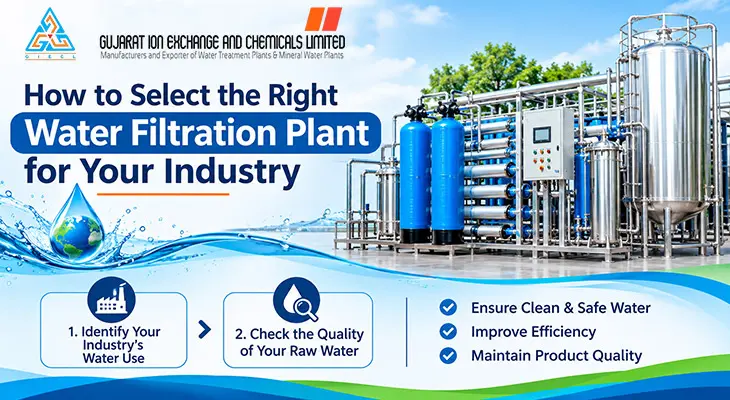
Begin by recognizing the application of water in your facility. Certain businesses utilise water for washing purposes, while other companies need quality control over water in their products.
For instance, pharmaceutical industries may need water that is purified for certain processing purposes. Food and beverage industries need water that has been treated according to the quality required by their process. Textile plants need water that is treated to manage the suspended impurities and hardening levels.
When deciding on the processes to be used it is advisable to determine the intended purpose first to avoid purchasing unnecessary equipment.
Analyze the water before selecting the right type of water filter system. Physical and chemical properties of the water in underground aquifers, municipal water systems, rivers, and other sources can vary significantly from one another.
The water analysis will help you identify turbidity, suspended solids, water hardness, dissolved solids, color, and other impurities. In some cases, microbiological analysis may be needed.
The results will help determine if sand filtration, activated carbon filtration, water softening, micron filtration, or extra filtration like reverse osmosis (RO) treatment is necessary for your facility. The choice of equipment based on the real water conditions results in an appropriate treatment design.
The different types of filtration technologies that are used tackle water quality problems. Treatment stages should be determined based on the contaminants found in testing.
Sand filtration: It aids in removing suspended particles and reduces the turbidity.
Carbon Filtration: It is used to remove color, odor, organic matter, and chlorine from the water under ideal conditions.
Softening of water (hardness of water in terms of calcium and magnesium): To prevent scales formation owing to hardness of water developed in tanks.
Micron cartridge filtration: Filters smaller particles that may have passed through the previous filtration steps.
Reverse osmosis: Removes dissolved salts and many other dissolved contaminants from the water with the help of a membrane.
A combination of these technologies may be needed in some facilities. For instance, pre-filtration and activated carbon treatment can be used to prepare water for the downstream RO system. Final configuration should be based on the desired water quality and operating conditions.
Before finalising plant capacity, estimate the amount of water that your facility uses on a daily basis and how much water it requires during peak hours. Take into account production schedules, cleaning needs, utility needs, and any planned production expansion.
The system could fail during peak demand if the system is too small. However, an oversized system will have higher initial costs along with operating costs and won't provide practical benefits.
Talk to your supplier about the rate of flow, duration of use, storage space and how much you expect to use in the future. They can be used to calculate an appropriate system size and configuration.
Selection of material for the filtration process would depend upon the chemistry of water, environment, and end use. Stainless steel, FRP, and other suitable materials can be chosen depending upon the design and operational conditions.
The second issue to be considered here is the degree of automation. In case of normal operation, the automatic control systems can be used, and for stable performance, appropriate instruments can be employed. Before making the decision, find out about maintenance, consumables replacement, cleaning requirements, and spare parts availability.
Cost of purchase is just one of the investments. The life cycle cost could be affected by operating expenses, electricity usage, replacement filter media, chemicals and periodic maintenance.
It is important to ensure that the supplier would be able to explain the treatment process. The ability to get maintenance information, operator training, and spare parts can be useful in avoiding any unnecessary downtime.
GIECL provides services in filtration and treatment of water for industries like dairy, sugar, hotels, and hospitals, among others. These include multiple grade filtration, activated carbon filtration, and water softening, as per the client's needs.
The first step in selecting an appropriate filtration system is to determine the quality of water, the required process, the capacity required and the long term operating cost. It is commonly believed that a good Water Filtration Plant can help to assure water quality, guard downstream equipment, and increase plant efficiency. GIECL provides filtration solutions customized according to each industrial application.
Discuss your water treatment needs with GIECL to determine what type of water filtration is best for your facility.
The appropriate system depends on the quality of the raw water, what kind of contaminants are present and what the system will be used for. Water tests provide information on the needed treatment stages.
Yes. The treatment stages and capacities should be matched to the need of the facility, and the configuration of the filtration systems can be different for various applications.
Maintenance frequency depends on water quality, operating hours, filter media, and system design. Follow the manufacturer's recommended inspection and servicing schedule.

309, Sarthik Square , TGB service
road, Near Info Tower,
S. G. Highway, Bodakdev,
Ahmedabad-380 054, Gujarat, India


© Copyright 1996 - Gujarat Ion Exchange And Chemicals Limited. All Rights Reserved
Powered By: #1 Vinayak InfoSoft - SEO Company Ahmedabad

 Ahmedabad, Gujarat
 +91 92281
90646
 sales@giecl.com

