

 By Admin |
 November 26, 2026
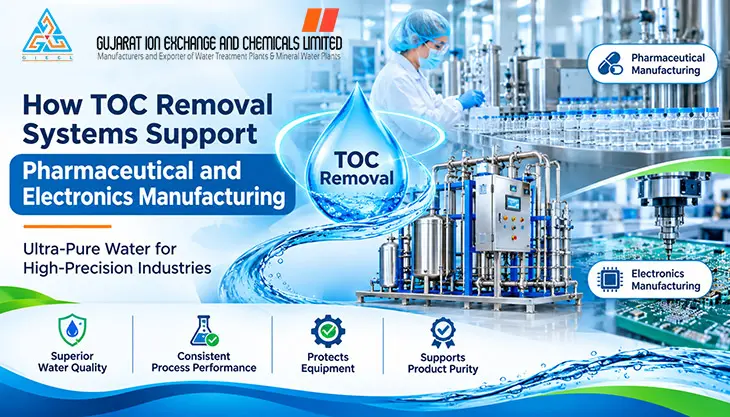
Water quality is essential for the consistency of industrial processes especially in pharmaceuticals and electronics production processes. Water can appear clear but contain trace amounts of organic contaminants that might affect the quality of the product, the cleaning process, or any of the machinery used during the processes. Total Organic Carbon (TOC) analysis determines the level of carbon in organic contaminants in water.
A TOC elimination system enables the elimination of organic contamination in water used in certain industrial applications. With the application of appropriate technology and monitoring systems, the quality of the water can be maintained as per the process requirements.
Organic substances may be present in the water either in the water source, in the storage tank, in the distribution pipes, or in other equipment within the treatment plant. This may include organic substances that have resulted from natural sources, process chemicals, and biofilm.
TOC analysis assists in determining the organic content in the water supplied to the manufacturing firm. The amount of organic matter considered to be acceptable will depend on the end use of the water and the specifications of the product.
Water quality control is essential in pharmaceutical production in many processes, such as cleaning of equipment, formulation, and production of pure water. The presence of organic impurities in the process water may cause some problems related to product contamination.
A suitable TOC treatment approach supports pharmaceutical manufacturers in several ways:
Water Quality Management: This assists in reducing organic substances that can impact water suitability for use.
Cleaning of Equipment: This assists in cleaning activities in which water quality is essential.
Consistency: This assists in ensuring water quality consistency when used with proper monitoring and maintenance activities.
Quality Assurance: This will assist in the quality assurance water management programs that need testing and control.
Pharmaceutical facilities should select treatment technologies based on their water quality specifications and applicable pharmacopoeial requirements. TOC reduction alone does not establish that water is suitable for pharmaceutical use. Microbial quality, conductivity, and other relevant parameters must also be evaluated.
The manufacturing of electronics may be prone to having sensitive parts, cleaning, and manufacturing processes in which contamination, however slight, can impact their function. The water used in the manufacturing of semiconductors, cleaning of printed circuit boards, and manufacturing of other electronic devices may need to be extremely pure.
Organic residues can coat the surfaces or make cleaning difficult or cause contamination in manufacturing. This is dependent on the process and the organic residues involved.
A properly engineered TOC elimination system will assist in minimizing organic impurities in a larger framework of ultrapure water treatment systems. Treatment will involve processes such as reverse osmosis, ultraviolet oxidation, deionization, and further polishing depending on the desired water quality.
Appropriate water quality management can facilitate clean surfaces on components and minimise contamination problems in the process. This comprehensive treatment system will have to be engineered based on the purity standards and operating conditions specified by the manufacturer.
TOC reduction generally involves a combination of water treatment technologies rather than one universal method. The right arrangement depends on the source water, the type and concentration of organic compounds, and the quality required at the point of use.
Common technologies include:
Reverse Osmosis (RO): Eliminates several dissolved contaminants and reduces the total contaminant level before further downstream treatment processes. It depends on the nature of the compound and membrane type for its efficiency.
Ultraviolet Oxidation: Makes use of the suitable UV wavelength, and in some cases, an oxidation reaction to convert the organic compounds to simpler forms. In some systems, a subsequent step will be necessary to eliminate the carbon dioxide formed in addition to other contaminants.
Deionization and polishing: Assist in controlling ionic contaminants following prior processing steps. These processes can be incorporated into an overall high-purity water system, based on application requirements.
Regular testing, preventive maintenance, and monitoring at appropriate points help determine whether the treatment process continues to meet the required specifications.
Before making any investment into a TOC removal system, manufactures should look at parameters including source water quality, required levels of TOC, flow rates, operating cycle time, and other needs of downstream equipment.
A water treatment technology that has been proven to be good for pharmaceutical applications doesn’t necessarily mean that it will fit into electronics manufacturing applications.
Control of contamination with organics in water is a reliable tool to guarantee high- quality water during the production of medicines and electronics. A proper design of a TOC control system may assist the manufacturer in controlling organic contaminants through its combination with adequate purification stages, analysis, and maintenance procedures.
GIECL provides water solutions for industrial and pharmaceutical needs.
For more information about our solutions, please get in touch with GIECL.
The abbreviation TOC stands for Total Organic Carbon. The definition is the amount of carbon present in the organic substances in water.
This ensures that pharmaceutical manufacturers can control organic contaminants in the process water and meet the water quality requirements of their applications.
This depends on the water quality and the required application, whereby the methods include reverse osmosis, UV oxidation, and deionization.

309, Sarthik Square , TGB service
road, Near Info Tower,
S. G. Highway, Bodakdev,
Ahmedabad-380 054, Gujarat, India


© Copyright 1996 - Gujarat Ion Exchange And Chemicals Limited. All Rights Reserved
Powered By: #1 Vinayak InfoSoft - SEO Company Ahmedabad

 Ahmedabad, Gujarat
 +91 92281
90646
 sales@giecl.com

